
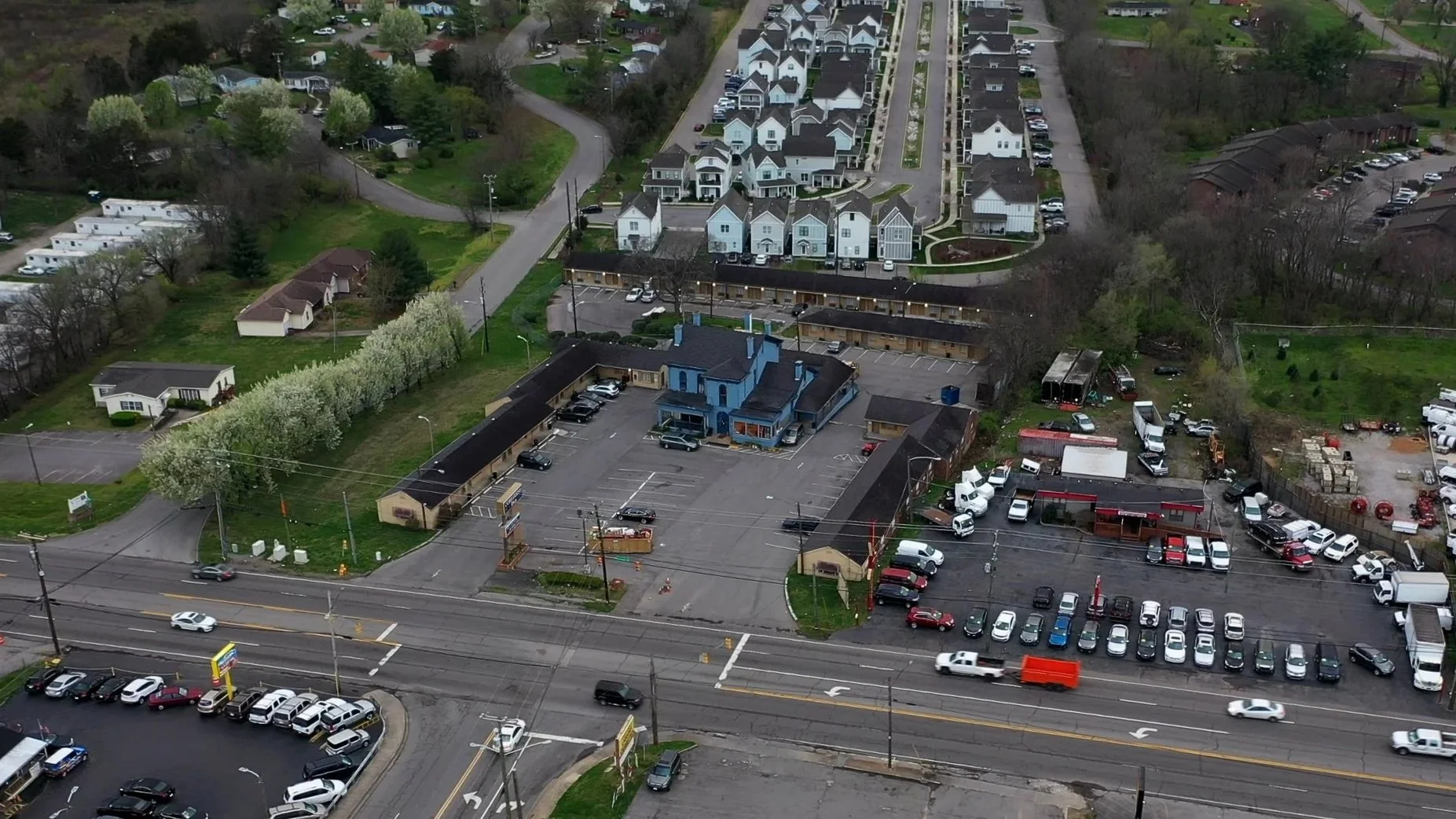
Finding the right property for Salt Ranch wasn't about luck. It was about knowing exactly what I wanted and having the discipline to wait for it. When the Congress Inn property on Dickerson Pike became a real opporunity, I knew within the first few hours that this was it. But before I could commit $3 million to the deal, I needed to know everything: the market, the zoning, the feasibility, the competitive landscape. That's what this post is about. I'm walking you through my entire due diligence process so you can apply the same framework to your next deal.
Finding the Congress Inn on Dickerson Pike
I wasn't actively searching for a motel in East Nashville. I was actively searching for a location. There's a difference. I'd spent months analyzing where the real estate market was moving in Nashville, and Dickerson Pike kept coming up as a corridor with massive upside. The Congress Inn property sat on 2.5 acres at a lighted intersection on a major thoroughfare. That's not a motel location. That's a location with motel-shaped real estate on it.
The property itself was a faded 52-room motor lodge with the bones of a different era. But the location was the asset. High-traffic corridor, visible from the highway, and zoned for high-density development. I'd been studying Dickerson Pike real estate developments long enough to know this area was transitioning. This wasn't about what the property was. It was about what the location could become.
The sellers originally wanted somewhere in the $4 million range, but I knew the actual value was lower. I made an offer at $2.5 million, they countered, and we settled at $3 million, or $1.25 million per acre. That gap between what people think property is worth and what it actually is worth? That's where deals live.
Zoning and the First Strategic Decision
Day one of due diligence was zoning. I pulled the property records and saw high-density zoning, which meant I had options. The original impulse was micro-apartments. Developers were building them all over East Nashville, and the numbers looked decent. I also considered micro-offices or even micro-retail, which were beginning to pop up across the city. All uses fit the zoning and had tenant demand.
But a motel wasn't just another box to fill. It was a strategic choice. The market data told me the Nashville hospitality scene was exploding, but I needed to dig deeper before I locked into that concept.
The Market Research: Nashville's Hotel Boom
Here's what the numbers told me. Nashville had 7,000+ rooms in the pipeline at the time I was analyzing this deal. The city led the nation in hotel industry growth in 2019. That's not hype. That's capital and development flowing into a market. Average daily rates were growing 7.4% per year. RevPAR, which is the real metric that matters, was up 8.9%. These weren't just vanity metrics. They meant there was real demand, and that demand was being backed by dollars.
But here's what really caught my attention: only 7% of Nashville's hotel market was boutique. That number stuck with me. The pipeline was full of standard, build-to-suit chains. Midscale, upscale, the usual suspects. But boutique? That was underrepresented. And that was where I believed the margin was.
I dug into the competitive landscape, specifically looking at boutique hotels in East Nashville and across the metro area. The market was thirsty for differentiation. Not just another hotel. Something with character, with story, with reason to choose it beyond price.
The Due Diligence Deep Dive
I brought in a hospitality consultant to validate my gut feelings. I needed an expert who'd done this before, who understood the mechanics of hotel operations, cash flow, and feasibility. The consultant ran the numbers with me. We built operating models. We looked at comparable properties. We stress-tested assumptions about occupancy, ADR, and cost structure.
What surprised me most wasn't what we found. It was what we didn't find. The Congress Inn property, despite its worn condition, had incredibly efficient bones for a boutique upgrade. The footprint worked. The room count was right-sized for the building. The parking situation, which is always a pain point in East Nashville, was solid. That's when I knew this wasn't just a location play. This was a real hotel opportunity.
I also studied the surrounding real estate market. I looked at new East Nashville hotels and how they were performing. I studied the broader market trends in East Nashville to understand neighborhood trajectory. The data kept pointing the same direction: this corridor was about to transform, and a well-executed boutique hotel would be positioned to capture that wave.
Why Hotel Over Other Uses
So why a hotel instead of apartments or offices? Three reasons. First, the revenue per square foot in hospitality, when done right, significantly outpaces residential. Second, the market data showed genuine structural demand. Third, and most important: I saw the opportunity to build something that didn't exist in Nashville's boutique market.
Micro-apartments could make sense mathematically, but they were commoditized. The market was flooded with supply, and that suppresses returns. A hotel was different. A well-branded, well-operated boutique hotel in an emerging neighborhood? That's not commoditized. That's a defensible asset.
I'd spent time researching how other entrepreneurs built their first hotels, learning from their mistakes and wins. That research reinforced my conviction that hospitality was the right play here.
Building the Feasibility Study
The feasibility study wasn't just a document. It was the map that would guide every decision for the next few years. We modeled occupancy scenarios. We built operating budgets. We stress-tested the economics under different market conditions. We looked at what it would cost to renovate the existing building versus demolishing and rebuilding.
The consultant and I looked at staffing models, revenue management strategies, and brand partnerships. We mapped out the customer journey and how the property would differentiate in the market. This wasn't theoretical exercise. This was tactical planning.
The Commercial Real Estate Framework
I want to zoom out here because this deal taught me a framework that applies to any commercial real estate investment. It's not complicated, but it's rigorous. First, identify the location. Second, understand the zoning and what that zoning allows. Third, research the market data for every viable use case. Fourth, bring in expert advisors to validate your assumptions. Fifth, build detailed financial models. Sixth, make the go/no-go decision.
This process takes time. It's not flashy. But it's how you avoid the mistakes that sink deals.
Key Takeaways from the Congress Inn Analysis
Location precedes use case. I found the location first. The use case (boutique hotel) came later, after market research validated the opportunity.
Market data beats intuition. The 7% boutique market share, the 8.9% RevPAR growth, the 7,000+ room pipeline. These numbers told a story that intuition alone couldn't.
Zoning flexibility is valuable. High-density zoning gave me options. I could have done apartments, offices, or hotel. Having choices increased the property's real value.
Bring in experts. The hospitality consultant I hired paid for himself by validating assumptions and catching risks I would have missed alone.
Build detailed financial models. Don't guess about occupancy, ADR, or costs. Model them. Stress-test them. Then model them again under different scenarios.
Feasibility studies are worth the investment. A solid feasibility study gives you the confidence to commit capital and the roadmap to execute successfully.
Premium positioning requires gap analysis. The 7% boutique market share told me there was white space. Finding white space in a commoditized market is where returns come from.
This analysis turned a $3 million real estate purchase into Salt Ranch, a boutique hotel that we hope will become a landmark in East Nashville. But it started here, with the boring, methodical work of due diligence.
If you're serious about building a boutique hotel or other commercial real estate projects, this framework is your starting point. Do the work upfront. The returns compound on a solid foundation.
What's Next
This post is part of the Salt Ranch Series, documenting the full story of building a boutique hotel in Nashville from finding the deal to financing, design, construction, and opening day.
Read the Full Salt Ranch Series:
How I Analyzed a $3 Million Motel Deal (You Are Here)
Boutique Hotel Design: How We Turned a 1950s Motel into Salt Ranch
How to Build a Hotel: The Development Timeline Nobody Talks About
How to Start a Boutique Hotel: Lessons from Building Salt Ranch
If you're working on a commercial real estate deal and want to accelerate your learning, I built the CRE Accelerator to walk you through this exact process. It's the framework I use for every deal, and it's available for anyone serious about commercial real estate investing.